
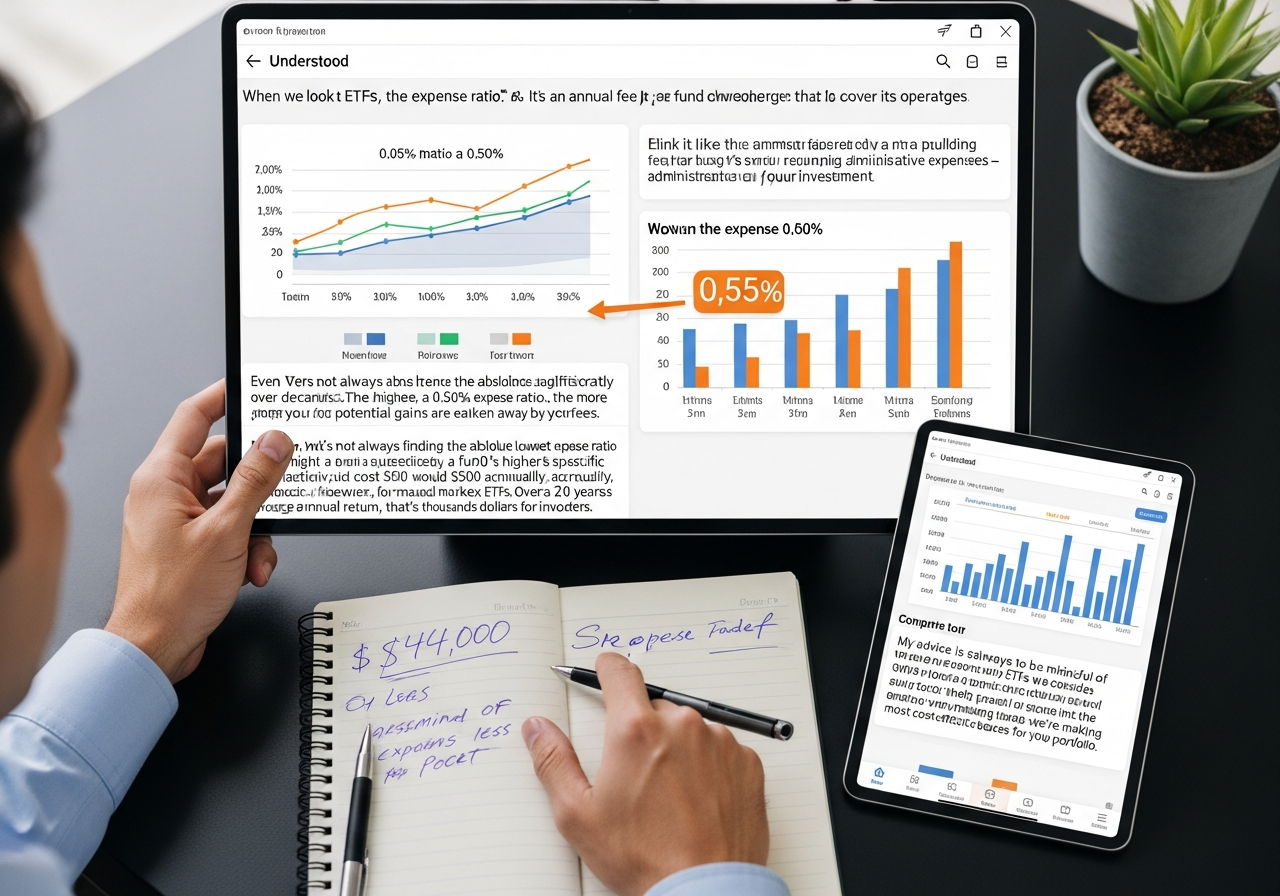
Exchange-traded funds (ETFs) have revolutionized investing by offering diversified exposure to various asset classes at relatively low costs. However, understanding the fee structure behind these popular investment vehicles is crucial for maximizing returns over the long term. Every ETF charges fees that directly impact your investment performance, making it essential to comprehend how these costs work and what you’re paying for.
ETF fees primarily consist of expense ratios and management fees, which are automatically deducted from the fund’s assets before returns are distributed to investors. These seemingly small percentages can significantly compound over time, potentially reducing your portfolio’s growth by thousands of dollars over decades of investing. The difference between a 0.05% expense ratio and a 0.75% fee might appear negligible, but this 0.70% gap can translate to substantial differences in long-term wealth accumulation.
Smart investors recognize that while fees shouldn’t be the only consideration when selecting ETFs, they represent one of the few factors entirely within your control. Unlike market performance, which remains unpredictable, you can directly influence your investment costs by choosing funds with competitive fee structures that align with your financial objectives.
Understanding ETF Expense Ratios
The expense ratio represents the annual fee charged by an ETF as a percentage of your total investment, covering the fund’s operational costs including portfolio management, administrative expenses, and regulatory compliance. This fee is automatically deducted from the fund’s net asset value daily, meaning you never write a separate check but instead see slightly reduced returns reflected in the ETF’s performance.
Components of Expense Ratios
Management fees typically constitute the largest portion of an ETF’s expense ratio, compensating the fund company for investment research, portfolio construction, and ongoing oversight. Administrative costs cover essential operational functions such as record-keeping, customer service, custodial services, and regulatory reporting required for fund compliance.
Marketing and distribution expenses, known as 12b-1 fees in mutual funds, are generally minimal or absent in ETFs due to their exchange-traded structure. Legal and audit fees ensure regulatory compliance and provide independent verification of fund operations, while transfer agent costs handle shareholder transactions and account maintenance.
Calculation Methods and Impact
ETF expense ratios are calculated by dividing the fund’s total annual operating expenses by its average net assets under management. For example, if an ETF with $1 billion in assets incurs $5 million in annual expenses, the expense ratio equals 0.50%. This percentage is then applied daily to determine the actual dollar amount deducted from the fund’s assets.
The cumulative impact of expense ratios becomes more pronounced over longer investment periods due to the compounding effect of fees on fees. An investor contributing $10,000 annually to an ETF charging 0.25% versus one charging 0.75% could see a difference of tens of thousands of dollars over a 30-year investment horizon, assuming identical underlying performance.
Types of Management Fees
Management fees vary significantly across different ETF categories, with passive index funds typically charging lower fees than actively managed strategies. Understanding these fee structures helps investors make informed decisions about which ETFs best suit their investment goals and cost tolerance.
Passive vs Active Management Costs
Passive ETFs that track established indices generally charge lower management fees because they require minimal ongoing research and trading activity. These funds simply replicate their benchmark index’s holdings, resulting in lower operational costs that translate to reduced fees for investors.
Actively managed ETFs employ professional portfolio managers who conduct research, analyze market conditions, and make strategic investment decisions aimed at outperforming benchmark indices. This active approach requires significant resources, including analyst teams, research databases, and sophisticated trading systems, resulting in higher management fees to compensate for these additional services.
| ETF Category | Typical Expense Ratio Range | Management Style | Primary Cost Drivers |
|---|---|---|---|
| Broad Market Index | 0.03% – 0.20% | Passive | Index licensing, minimal trading |
| Sector-Specific | 0.40% – 0.80% | Passive/Active | Specialized research, higher turnover |
| International/Emerging Markets | 0.50% – 1.20% | Passive/Active | Currency hedging, foreign regulations |
| Actively Managed Equity | 0.60% – 1.50% | Active | Portfolio management, research teams |
| Alternative Strategies | 0.75% – 2.00% | Active | Complex strategies, specialized expertise |
Hidden Costs and Additional Fees
Beyond the clearly stated expense ratio, ETFs may incur additional costs that don’t appear in the fund’s published fee schedule but can impact overall investment returns. These hidden expenses often relate to trading activities, securities lending, and operational inefficiencies that vary based on market conditions and fund management practices.
Trading Costs and Bid-Ask Spreads
ETFs trade on exchanges like individual stocks, subjecting investors to bid-ask spreads and potential trading commissions depending on their brokerage arrangement. The bid-ask spread represents the difference between the highest price buyers are willing to pay and the lowest price sellers will accept, effectively creating a transaction cost for investors.
Highly liquid ETFs tracking popular indices typically maintain tight bid-ask spreads, often just a few cents per share, while specialized or low-volume funds may exhibit wider spreads that increase trading costs. These costs become more significant for frequent traders or those making small, regular investments in funds with poor liquidity.
Portfolio Turnover and Transaction Fees
Internal portfolio turnover generates transaction costs as fund managers buy and sell underlying securities to maintain proper index tracking or implement investment strategies. While these costs don’t appear as separate line items, they reduce fund performance and are reflected in tracking error relative to benchmark indices.
Securities lending programs, where funds lend portfolio holdings to short sellers in exchange for fees, can offset some operational costs but may introduce counterparty risk and operational complexity. The net impact of securities lending typically benefits shareholders through reduced effective expense ratios, but the practice involves additional risks that investors should understand.
Cost Comparison Strategies
Effective ETF cost analysis requires comparing similar funds across multiple fee dimensions while considering the total cost of ownership rather than focusing solely on expense ratios. This comprehensive approach helps identify the most cost-effective options for achieving specific investment objectives.
Benchmarking Against Peers
Compare ETFs within the same category using standardized metrics such as expense ratios, tracking error, and total return after fees. Focus on funds with similar investment objectives, geographical exposure, and market capitalization targets to ensure meaningful comparisons.
Consider the trade-off between lower fees and tracking accuracy, as some ultra-low-cost funds may exhibit higher tracking error that potentially offsets their fee advantage. Evaluate historical performance data to determine whether higher-cost funds consistently deliver superior risk-adjusted returns that justify their premium pricing.
Analyze fund size and assets under management, as larger funds often benefit from economies of scale that enable lower expense ratios. However, extremely large funds may face liquidity constraints in smaller market segments that could impact performance, particularly during volatile market conditions.
- Total Cost Analysis: Calculate the combined impact of expense ratios, trading spreads, and potential commission costs based on your investment frequency and dollar amounts
- Performance After Fees: Review multi-year net returns to assess whether any fund consistently outperforms peers by enough to justify higher costs
- Tracking Efficiency: Examine tracking error statistics to identify funds that most closely replicate their benchmark performance at the lowest cost
- Tax Efficiency: Consider the tax implications of fund distributions and turnover rates, as tax-efficient funds can provide better after-tax returns despite slightly higher expense ratios
- Fund Stability: Evaluate the fund company’s commitment to maintaining competitive fees and their history of fee reductions as assets grow
- Investment Minimums: Compare any minimum investment requirements and account fees that could impact smaller investors disproportionately
Impact on Long-term Returns
The compound effect of ETF fees over extended investment periods can dramatically influence portfolio growth, making cost consideration a critical component of long-term wealth building strategies. Even seemingly modest fee differences compound significantly over decades, potentially affecting retirement security and financial independence timelines.
Compounding Effects Over Time
Fee impact accelerates over time as investors pay percentage-based charges on increasingly larger account balances, including previous returns that were already reduced by fees. This compounding effect means that a 0.5% annual fee doesn’t simply reduce returns by 0.5% each year but creates a growing drag that becomes more substantial as portfolio values increase.
For investors contributing regularly to ETF positions over many years, the cumulative fee impact includes charges on both new contributions and accumulated gains from previous investments. This creates a multiplier effect where higher fees not only reduce current returns but also diminish the base amount available for future compounding growth.
Real-World Portfolio Scenarios
Consider an investor contributing $500 monthly to an ETF portfolio over 30 years, assuming a 7% annual return before fees. An ETF charging 0.20% annually would result in a final portfolio value approximately $15,000 higher than an identical fund charging 0.70%, demonstrating how fee differences translate to meaningful wealth disparities.
The relative impact of fees becomes more pronounced for larger portfolios and longer time horizons, making cost optimization particularly important for young investors with decades until retirement. Investors nearing retirement may prioritize other factors such as capital preservation or income generation, where slightly higher fees might be justified for specialized strategies or professional management.